ROTTERDAM - Did you know that commuters on the edge of Rotterdam have been riding to work in minibuses with no driver since the last century? In February 1999, three small electric shuttles began carrying passengers between the Kralingse Zoom metro and bus station and the Rivium business park in neighboring Capelle aan den IJssel, over a closed 1,300-meter track, with a computer doing the driving.
The ParkShuttle was built by Frog Navigation Systems, a Utrecht company whose automated vehicles already worked in factories and at the container terminals of the Port of Rotterdam. The trial began in 1997, according to a 2018 study by researchers from Delft University of Technology, Rotterdam University of Applied Sciences and 2getthere, Frog's people-mover business. For the first three months the shuttle ran empty; for the next three, test passengers rode it while crossing traffic was simulated, with a steward on board. A municipal press release on 8 July 1997, listed in the study's references, was headlined "Wereldprimeur," Dutch for world first, and announced the first people carried in the shuttle. Eventually regular passengers rode with no steward at all.
It worked like a horizontal elevator. Riders pressed a button at the stop to call a shuttle, then pressed another inside to pick their destination, according to a 2getthere project description archived by the University of Washington. Each vehicle stored an electronic map of the route, counted its wheel turns to track its position and checked itself against magnets set in the asphalt. A supervisory computer called SuperFROG dispatched the shuttles by radio and worked the traffic lights and barrier gates where the track crossed other traffic. Each first-generation shuttle held 10 passengers, six of them seated, and its speed was capped at 40 kilometers per hour.
Ridership soon outran the plan. By September 2001 the shuttles were carrying more than 600 passengers a day, against 250 in the budget, and riders gave the service a score of 7.9 out of 10, the Dutch technology publication Computable reported. Each vehicle cost about 450,000 guilders, roughly the price of a city bus. "But eliminating the driver saves a lot in costs," Robbert Lohmann of Frog told the publication. The early shuttles were cautious to a fault. They stopped for every obstacle, including pigeons and newspapers blowing across the track, until engineers added a second laser scanner and retuned the settings, the Delft researchers wrote.
In December 2001, on the strength of that success, the decision was made to take the system beyond pilot status, according to 2getthere. A larger second generation, built by 2getthere with design by Duvedec and chassis and drivetrain by Spijkstaal, followed on a longer, mostly two-lane route with five stops, carrying up to 24 passengers each. It had a rough start. On 6 December 2005, two of the new shuttles collided on a single-lane bridge over a highway. Neither carried passengers. An operator had released that section of track twice, giving shuttles at both ends permission to enter, and the bridge's vertical curve, which had not been built to specification, kept their sensors from detecting each other in time to stop, the study found. The shuttles were back in service in September 2008.
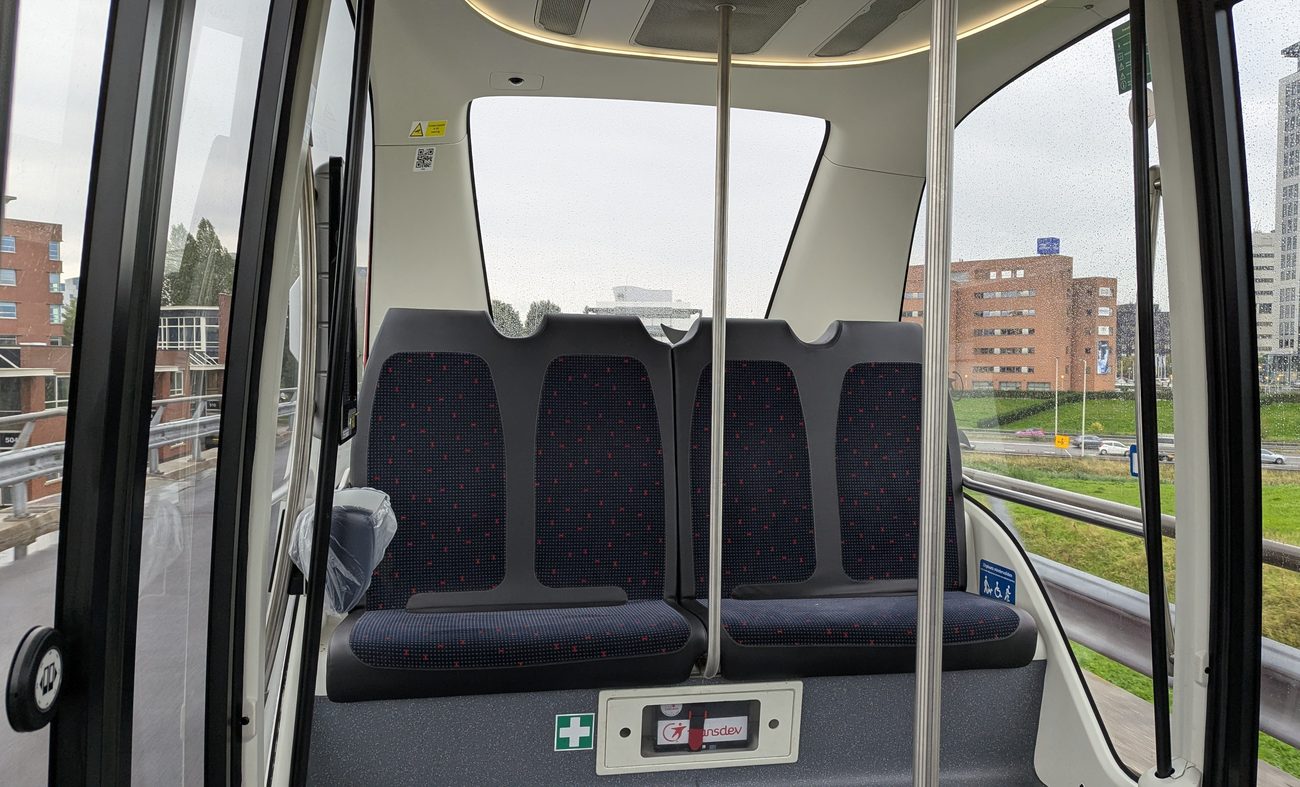
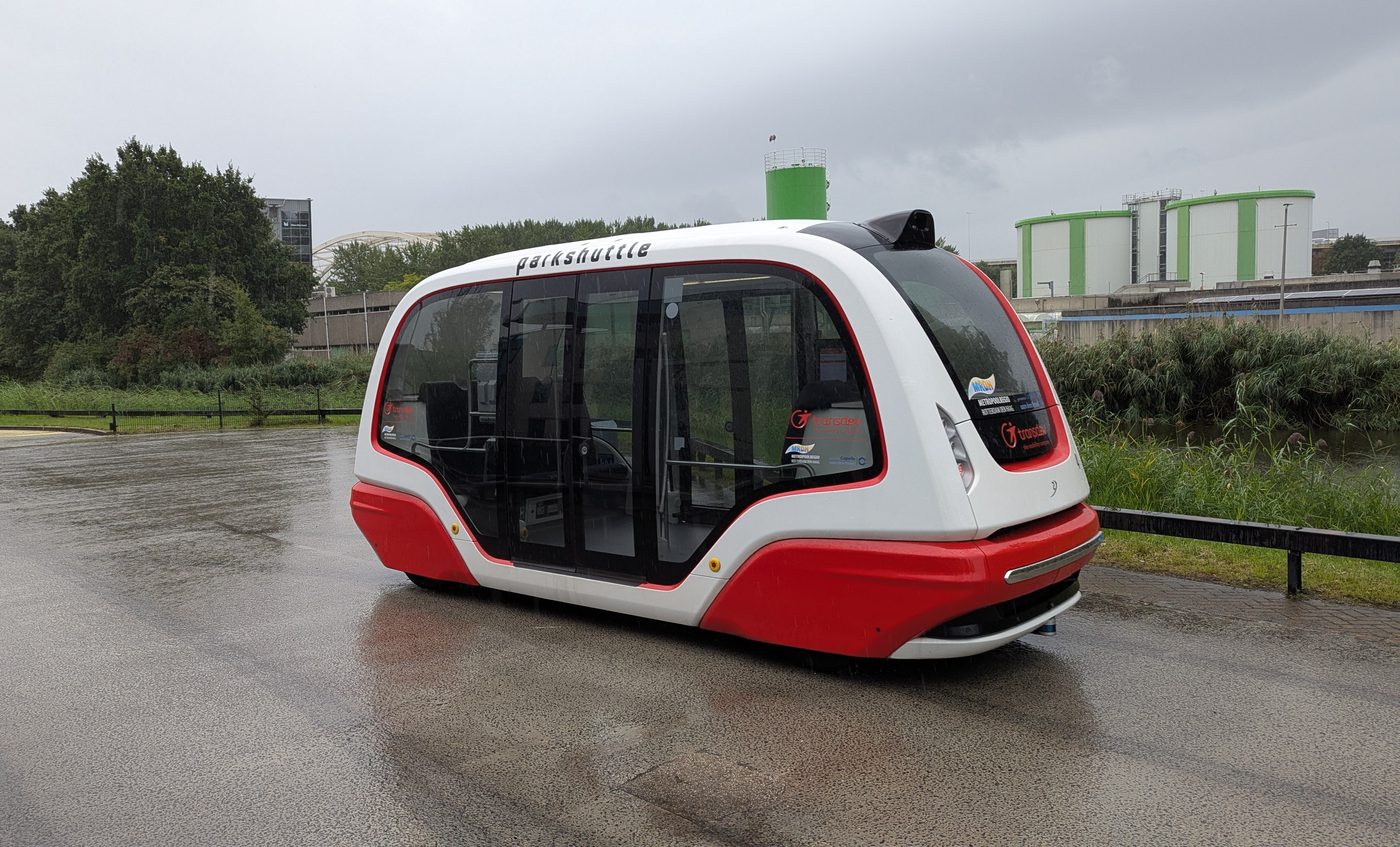
The third generation arrived late. The previous shuttles were taken out of service in 2019, and setbacks in developing, building and testing the new vehicles, along with the coronavirus pandemic, kept the line closed for three years, the Rotterdam The Hague Metropolitan Region said when six new shuttles began carrying passengers on 5 December 2022. Transdev, the parent company of Connexxion, runs them under what the region calls the smallest public transport concession in the Netherlands. Before the pandemic, the line carried an average of 1,850 passengers a day.
Today the shuttles run on weekdays from 6 a.m. to 9 p.m., every two and a half minutes at rush hour and partly on demand the rest of the day, according to Transdev. They still follow a fixed route on their own lane and use magnets in the road to know where they are, while a central control room watches over them.
Plans to send the ParkShuttle out among ordinary traffic have proved harder. The 2018 study expected the new shuttles to run about 300 meters on public roads by 2020. In its 2023 annual report, the municipality of Capelle aan den IJssel said it hoped to test the shuttle in mixed traffic in 2024 but that the chance was small. Transdev told the newspaper NRC in July 2025 that, given strict European Union safety rules, mixed traffic was not yet an option in the short term.
More than 27 years after the first public runs, commuters at Rivium still press a button and wait for a shuttle that no one drives.