PARIS - Did you know that in October 1994, nearly a decade before the first DARPA desert race for robot vehicles, two gray Mercedes-Benz sedans drove themselves through ordinary traffic on the A1 autoroute north of Paris? With guests on board, they held their lanes at up to 130 kilometers per hour (about 81 miles per hour), the French speed limit, followed other cars at a safe distance and changed lanes to pass them.
The cars were VaMP, built by Ernst Dickmanns' team at the University of the Bundeswehr Munich, and its twin VITA-2, run by Daimler-Benz. Both began as secondhand Mercedes 500 SEL sedans of the W140 S-Class generation, Dickmanns wrote in his own account of the work. They were the showpiece of the final demonstration of PROMETHEUS, a European research program on safer, more efficient road traffic that Daimler-Benz launched with partners in 1986. Dickmanns told Politico in 2018 that Daimler's request to drive on a three-lane motorway in public traffic had first struck him as "absurd."
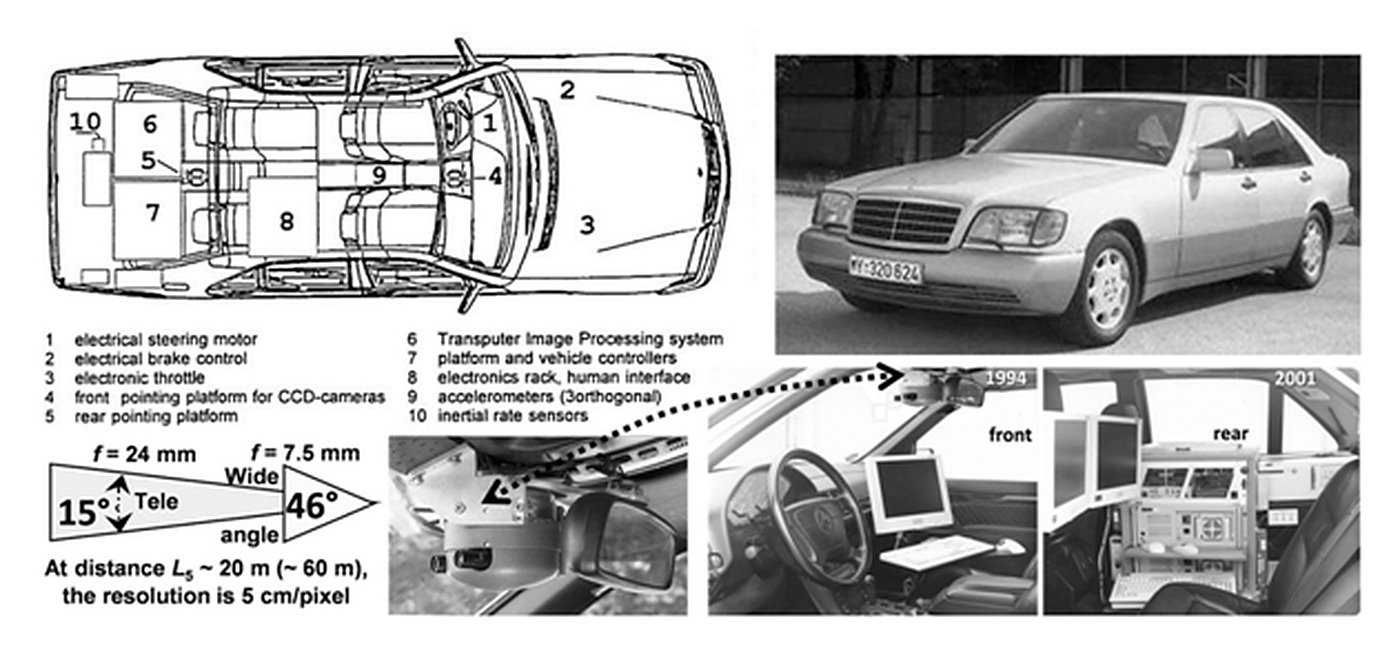
The sedans found their way by machine vision. Each carried two pairs of small video cameras on turning platforms, one pair looking ahead and one behind, each pairing a wide-angle lens with a telephoto. In VaMP, a network of up to 60 transputers, a parallel processor of the era, tracked lane markings 12.5 times a second, estimated the position and speed of up to five nearby vehicles from the camera images alone, and sent commands to an electric steering motor, the brakes and the throttle. A safety driver sat behind the wheel at all times. When the system judged a neighboring lane clear, it asked to change lanes. The driver agreed by setting the turn signal, and the car made the move itself.
Dickmanns' team picked up high-ranking guests at Charles de Gaulle airport, drove them to the nearby autoroute and switched both cars into self-driving mode, Politico reported. Over the demonstrations that autumn, the cars covered well beyond 1,000 kilometers (about 620 miles) under computer control on the autoroutes around Paris, Dickmanns later wrote, and Mercedes-Benz has said its research car alone covered more than 1,000 kilometers that October. In one maneuver his team recorded on video, VaMP trails a bus in the right lane and asks to move left, just as the bus pulls out too. The car eases off, settles in behind the bus in the center lane, asks again, moves to the outer lane, passes and later returns to the right.
It was not flawless. The system needed good weather and light, Dickmanns wrote. Reinhold Behringer, an engineer who sat in the driver's seat in Paris, told Politico the lane finder ran into trouble when a car ahead hid the markings on one side and the markings on the other side had worn away.
The sedans grew out of a decade of work. In 1985 Dickmanns' institute fitted a five-ton Mercedes-Benz van, called VaMoRs, with cameras and computers. In December 1986 it controlled its own steering and speed on a skidpan for visiting Daimler-Benz researchers in Stuttgart. In 1987 it drove at up to 96 kilometers per hour, the van's top speed, on an empty stretch of autobahn near Dingolfing in Bavaria, according to Dickmanns.
The team went farther a year after Paris. In November 1995 VaMP, by then running faster PowerPC processors, drove from Munich to a project meeting in Odense, Denmark, and back. It covered more than 1,600 kilometers under computer control, about 95 percent of the distance attempted, topped 175 kilometers per hour on open autobahn and made more than 400 lane changes when the safety driver asked for them. Its longest stretch without human help was about 160 kilometers. Construction zones caused many of the interruptions: German work zones mark lanes in yellow, and the car's black-and-white cameras could not tell those lines from the old white ones.
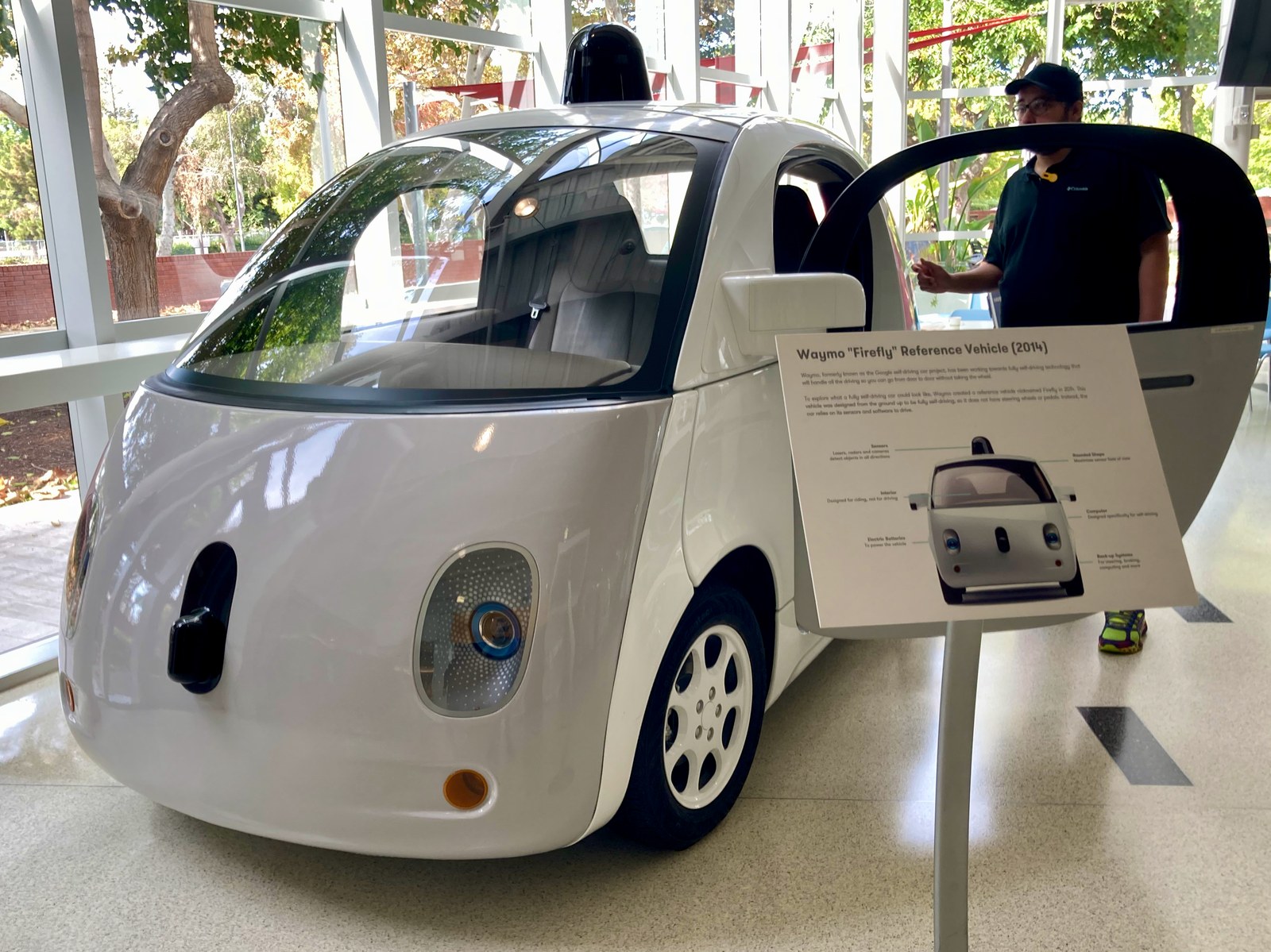
VaMP sits among the research vehicles in Hall III of the Deutsches Museum's transport center in Munich, the museum said in 2020, when it added a Waymo Firefly to the same branch. The Firefly is the prototype with no steering wheel or pedals that Waymo says made the world's first fully driverless trip on public roads in 2015.