Rain Check: Viral Waymo Storm Clip Revives Musk’s LiDAR Dig
A rain-slick Waymo clip paired with Elon Musk's old line that LiDAR scatters in precipitation is circulating again as Waymo opens in wet markets and Tesla posts its own storm videos.
Priya Nair, Safety · Sept. 15, 2026
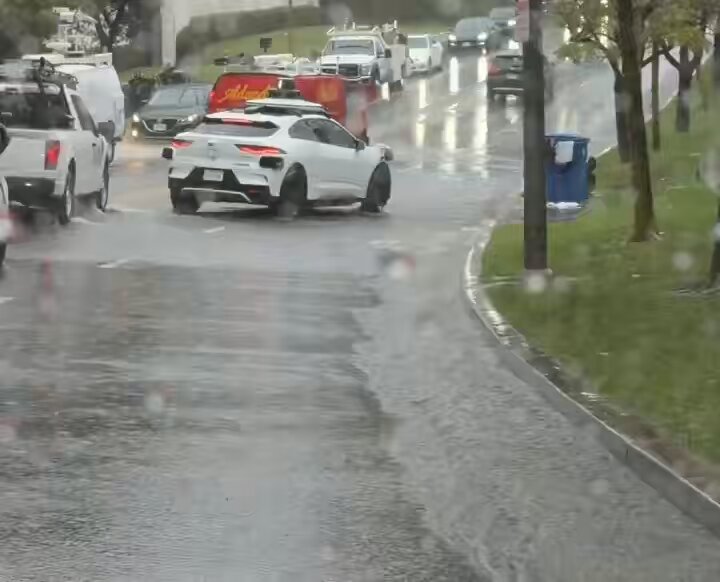
LOS ANGELES - A Japanese social account recirculated a months-old Waymo rain clip on Tuesday, pairing Elon Musk’s critique of LiDAR in wet weather with footage framed as yesterday in LA,” and sending an old sensor fight back into the autonomous-driving feed without a fresh Los Angeles storm to match the post’s timing.
Tesla commentator Nic Cruz Patane posted the video on Feb. 17, overlaying Musk's Aug. 26, 2025 post. The clip has been viewed nearly 3 million times. Musk replied, "Yeah." On Sept. 15, Tippy (@kaseimeme) recirculated the clip.
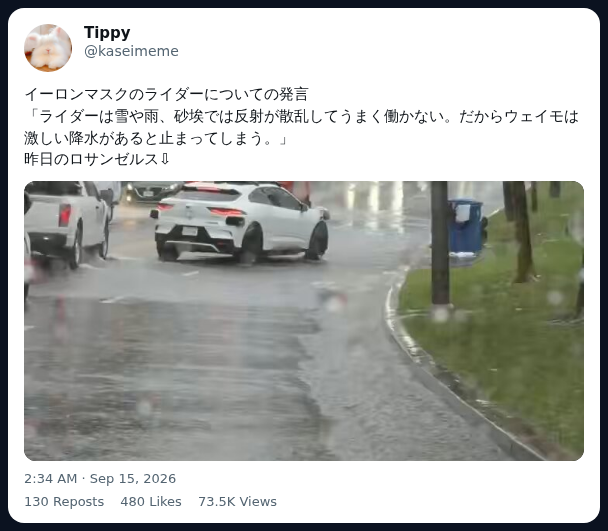
LiDAR also does not work well in snow, rain or dust due to reflection scatter. That's why Waymos stop working in any heavy precipitation.
Musk added that there is a role for LiDAR in some circumstances and that he oversaw LiDAR development for SpaceX Dragon docking with the space station. Tesla's Cybercab and Full Self-Driving stack remain camera-based. Musk has previously called LiDAR "a fool's errand" and said anyone relying on it is "doomed."
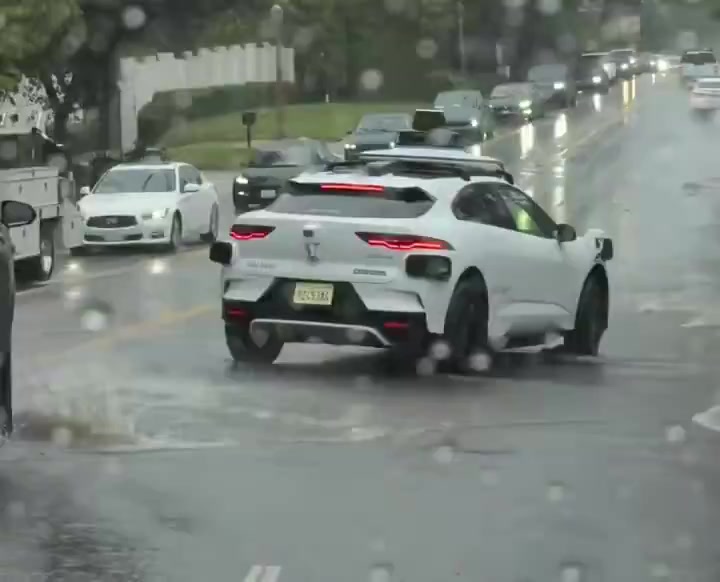
Waymo's wet-weather record is mixed. In May the company issued a software recall covering 3,791 vehicles after robotaxis entered flooded roads, including an unoccupied car that stalled in Atlanta floodwater and a San Antonio vehicle that was washed toward a creek. Waymo paused service in multiple cities around storms, TechCrunch reported.
Georgia Tech researcher Glen Chou, speaking after the Atlanta stall, said LiDAR and radar are not particularly well suited to estimating how deep a puddle is. Analysts have described a related failure mode: a laser pulse can glance off standing water so little signal returns, and a flooded patch can register as empty pavement.
At Waymo, camera, lidar and radar are treated as complementary, rather than competing, and redundancy is a requirement, not a luxury.
Dolgov has said cameras give high-resolution color but degrade in darkness and glare, LiDAR maps 3D structure, and radar holds up better in fog, rain, and snow. The stack fuses those feeds rather than switching from one sensor to another. In February Waymo said its sixth-generation Driver, with denser cameras and longer-range LiDAR, was built to see better in rain, sleet, and ice.
The argument is live again because Waymo opened public service this month in Tampa, a flood-prone market, and in Las Vegas, while Tesla accounts posted Cybercab and Full Self-Driving clips in heavy rain. Musk's camp treats wet-road video as proof vision is enough. Waymo's camp treats the same weather as the reason for a fused stack.
Neither clip settles the physics. LiDAR can scatter in rain. Cameras can wash out in spray and glare. Radar degrades differently. What the viral tape shows is a Waymo still moving in the wet, and a years-old Tesla talking point riding along.
Priya Nair covers safety, regulation, and vehicle performance for Driverless News.