LAS VEGAS - Motional has open-sourced nuReasoning, a reasoning-centric dataset of long-tail driving scenarios meant to teach autonomous vehicles not only what to do next but why, the Hyundai Motor Group majority-owned robotaxi company said in a Sept. 8 announcement.
The release pairs the public dataset with a research challenge launched at the European Conference on Computer Vision in Sweden, Motional said, in partnership with the UCLA Mobility Lab and Professor Jiaqi Ma. Challenge winners are scheduled to be announced in December at the Conference on Neural Information Processing Systems.
nuReasoning includes about 20,000 clips of at least 20 seconds each, totaling more than 105 hours of carefully selected edge cases mined from Motional fleet data in Las Vegas, Pittsburgh, Los Angeles, Boston and Singapore, according to the company. Motional said the collection covers unusual pedestrian activity, work zones and night road construction, animal crossings and limited-visibility scenes, with multi-modal sensors for a full 3D scene representation.
Unlike earlier open AV datasets focused mainly on perception, Motional said each long-tail event is annotated with human-verified reasoning so researchers can see why an action was taken and why alternatives were ruled unsafe. The company reported 247,000 reasoning annotations spanning spatial reasoning, decision reasoning and counterfactual reasoning. A smaller nuReasoning miniset released earlier this year has already been downloaded more than 50,000 times, Motional said.
One example Motional highlighted is a nighttime construction zone where a vehicle stops before moving forward. Without annotations, the pause could look like confusion. The labeled scenario instead shows the system waited for a small animal crossing ahead, and rejected alternate routes blocked by construction barriers and by the animal's unknown speed and direction.
"To safely expand AV fleets, autonomous driving systems must react to rare, chaotic edge cases with the same assured logic as an experienced human driver," Phil Michel, Motional's senior vice president of autonomy and AI, said in the company release. "By making nuReasoning openly available, we're offering a shared foundation to help the entire industry solve edge cases and advance toward scalable autonomous operation."
Motional said researchers also get its Omnitag search layer to query the dataset by scenario type, difficulty and location, including natural-language searches for complex tactical interactions. The challenge evaluates planning and reasoning on 1,000 private-test scenarios, combining explainable trajectory and motion planning with long-tail visual question answering and scene reasoning. Unite.AI reported a $10,000 prize pool and a scoring mix weighted 75 percent to planning and 25 percent to reasoning.
The company framed nuReasoning as the next step in an open-data line that began with nuScenes in 2019 and continued through nuImages, Panoptic nuScenes and nuPlan. Academic use is free under Motional's non-commercial terms, and commercial licensing is available, Motional said.
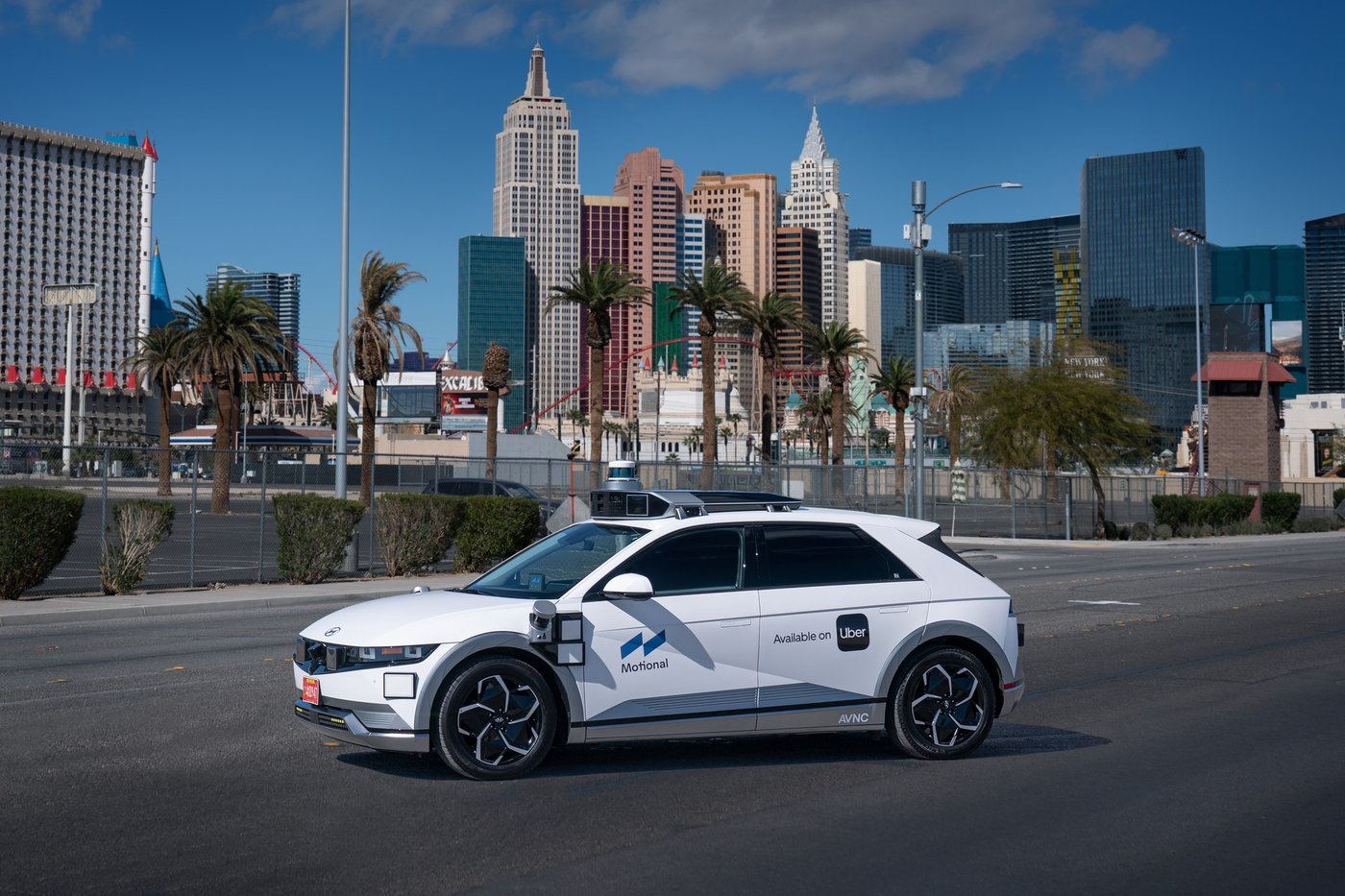
Motional already runs IONIQ 5 robotaxis with Uber riders in parts of Las Vegas, with a vehicle operator still onboard and fully driverless service targeted for later this year in company and partner materials. The nuReasoning release is aimed at the wider AV research stack rather than a new city launch, but it sits beside Motional's commercial ride-hail push as the industry races to handle the rare scenes that break brittle planners.